
If your Achilles tendon pulls after a run, your knee twinges when climbing stairs, or your shoulder feels stiff after sitting for a long time, collagen for joints and tendons quickly comes to mind. Understandable: collagen is a key building block of connective tissue. However, it is not an instant remedy and replaces neither targeted exercise nor a medical consultation for persistent symptoms. When used correctly, however, it can be a useful addition to a conscious exercise routine.
Why collagen for joints and tendons is interesting
Collagen is the most common protein in the human body. It gives skin, bones, cartilage, ligaments, and tendons structure and resilience. In joints, collagen type II is a key component of cartilage, while tendons consist predominantly of collagen type I. These tissues are constantly challenged: by sports, strength training, long workdays, one-sided movements, or simply by aging.
The body produces collagen itself from amino acids. For this, it needs sufficient protein and certain micronutrients, above all vitamin C. With increasing age, collagen metabolism changes. Smoking, high alcohol consumption, excessive UV exposure, lack of sleep, and a persistently very one-sided diet can also negatively affect the body's own processes.
Hydrolyzed collagen, also known as collagen peptides, is broken down into smaller protein building blocks. This makes it easy to stir into water, coffee, smoothies, or porridge. After digestion, amino acids and peptides enter the metabolism. What happens next depends on many factors: overall protein intake, training load, age, health status, and consistency of intake.
What research says about collagen and exercise
Studies on collagen peptides show interesting, but nuanced results. Especially among active people and individuals with exercise-related joint discomfort, some studies indicate that regular intake can support subjectively perceived joint function or comfort during exercise. Collagen is also being researched in connection with strength training and targeted tendon loading.
This does not mean that collagen "repairs" cartilage or heals an injured tendon. Such statements would be overreaching. Tendons respond primarily to measured mechanical stimuli: slow strength training, eccentric exercises, sufficient recovery, and gradual progression are the main pillars. Collagen can be part of the nutritional foundation—but exercise provides the crucial stimulus.
Anyone experiencing significant swelling, instability, an injury, severe pain, or symptoms lasting several weeks should have this examined by a doctor or physiotherapist. Dietary supplements are a supplement, not a diagnosis or therapy.
Not every collagen serves the same purpose
Packaging often contains references to collagen types I, II, or III. For everyday use, it is especially important to understand: collagen peptides are not a targeted delivery directly into the knee or Achilles tendon. They are digested and used as building blocks. Type I collagen is often mentioned in the context of skin, bones, tendons, and ligaments. Type II is more closely associated with cartilage.
In addition, there is non-denatured collagen type II in very small doses. It works differently than hydrolyzed collagen peptides and is therefore used differently. Anyone comparing products should look not only at the type of collagen, but also at the specific daily serving, the ingredients list, and the recommended intake. More is not automatically better.
Collagen in combination with OPC—why this combination is increasingly coming into focus in research
In addition to the quality and quantity of collagen peptides, the combination with other bioactive substances is increasingly coming into focus in scientific studies. OPC (oligomeric proanthocyanidins) from grape seed extract is considered a particularly interesting companion. OPC belongs to the group of polyphenols and has pronounced antioxidant properties. Free radicals are produced, among other things, during intense physical exercise, UV exposure, or natural metabolic processes, and can affect the balance between stress and recovery.
Laboratory and preclinical studies show that OPC can interact with collagen fibers and influence their cross-linking. Furthermore, research is exploring the extent to which antioxidant plant substances can support the natural function of collagen-rich connective tissue under stress. For joints, tendons, and ligaments, which are exposed to high mechanical forces daily, this combination is particularly interesting from a scientific perspective. However, clinical data is still developing, so no therapeutic conclusions can currently be drawn from it.
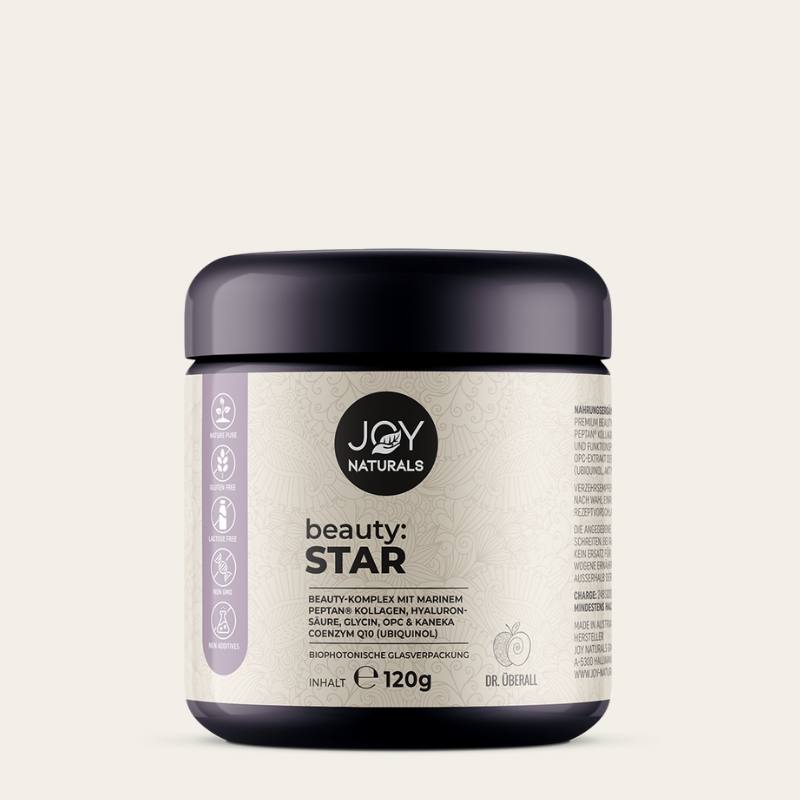
For people who want to make their daily routine as comprehensive as possible, a combination product can therefore be useful. For example, the beauty:STAR Powder Complex combines high-quality fish collagen peptides with OPC from grape seed extract, hyaluronic acid, glycine, and Coenzyme Q10 (Kaneka-Ubiquinol). While collagen provides the necessary protein building blocks, glycine complements the formula as an important collagen amino acid. Hyaluronic acid is a natural component of connective tissue and joint fluid, OPC provides valuable polyphenols, and Coenzyme Q10 supports the normal energy metabolism of cells. Together, this creates a well-thought-out combination that can be easily integrated into the daily diet—for example, in a smoothie, porridge, or shake—and can sensibly complement a balanced diet and regular exercise.
How to make collagen part of an everyday routine
With collagen, consistency counts more than perfection. Studies often use daily amounts in the range of about 5 to 15 grams of hydrolyzed collagen peptides over several weeks or months. What amount is individually useful cannot be determined universally. Body weight, diet, training volume, and goals all play a role.
A fixed time that already fits into your day is practical: for example, with breakfast, as a shake after training, or in a warm drink in the afternoon. Collagen peptides are generally heat-stable and neutral to mild in taste. This makes it easy to integrate them into familiar rituals, rather than having them end up as another item on a long to-do list.
Vitamin C should ideally be included, because it is needed for the body's own collagen formation. This does not have to be a complicated combination product. A glass of water with lemon juice, berries in porridge, kiwi, bell pepper, or a high-quality vitamin C complex can easily fit into the same meal. What matters is an overall nutrient-rich diet, not the pursuit of the one perfect timing.
Training remains the strongest partner
For resilient tendons and mobile joints, the body needs appropriately dosed stimuli. Those who are new to it or returning after a break benefit from small, steady steps. Two to three targeted strength training sessions per week, daily walks, and mobility sessions can do far more than a highly dosed supplement without exercise.
Make sure you get enough protein throughout the day. Depending on activity and life phase, requirements can vary significantly. Good plant-based sources are legumes, tofu, tempeh, soy yogurt, nuts, seeds, and high-quality protein powders. For athletes, it is often helpful to spread protein over several meals rather than eating most of it in the evening.
Recovery also deserves its place. Sleep, energy intake, and breaks also determine how well tissue can adapt to training. Anyone who consistently eats too little or wants to train away every pain makes it harder for the body to recover—regardless of whether collagen is in the kitchen cupboard.
Recognizing quality: What matters when buying
Collagen is obtained from animal raw materials, mostly beef, pork, fish, or poultry. Classic collagen is therefore not vegan. "Vegan collagen" often refers to products with amino acids, vitamins, and plant substances intended to support the body's own collagen formation. This can be a sensible option for people living a vegan lifestyle, but it is not equivalent to hydrolyzed collagen peptides. Transparency on the label is particularly valuable here.
With a collagen product, it is worth taking a close look at the origin and composition. A clear indication of the daily collagen amount is more helpful than vague marketing terms. Also pay attention to whether it contains unnecessarily high amounts of sugar, artificial flavors, or fillers. Anyone who reacts sensitively to fish or has allergies should carefully check the raw material source.
Quality is also shown in traceable testing processes, transparent manufacturing, and an ingredients list that fits your own everyday life. A neutral-tasting powder is ideal for purists. An flavored variant may, in turn, be the better choice if it helps you actually maintain the routine. Health can be practical and taste good.
Who collagen may be suitable for—and who it may be less suitable for?
Collagen can be interesting if you run regularly, do strength training, hike a lot, work physically, or want to consciously support your musculoskeletal system with increasing age. After longer training breaks, a comprehensive routine of protein, micronutrients, exercise, and recovery can also be useful.
Collagen is less suitable if you live a purely plant-based lifestyle and do not want to use animal products. In that case, a protein-rich diet, vitamin C, and nutrients such as zinc and copper are the focus. For pre-existing conditions, pregnancy, breastfeeding, or taking medication, individual consultation with a medical professional is part of the process.
Noticeable changes are rarely a matter of days. Rather, observe over eight to twelve weeks: How regularly do you train? How does the exercise feel? Are you getting enough sleep? How well are you managing a protein- and nutrient-rich diet? These questions bring you closer to a sustainable routine than any big promise.
Your joints and tendons accompany you with every step, every repetition, and every little adventure. Give them reliable movement, genuine recovery, and nutrients that fit into your everyday life—lovingly, consistently, and without pressure.