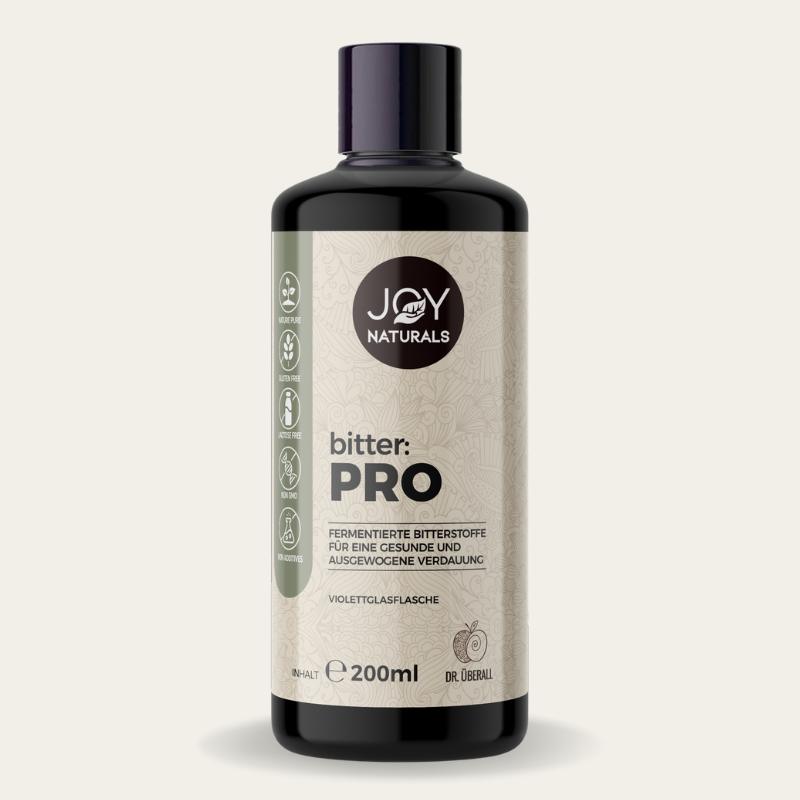

Because bitter compounds are not an afterthought.
They are a signal.
A stimulus that tells your body:
👉 Digestion is starting now.
👉 Activation is happening now.
👉 Regulation is happening now.
Without this stimulus, many processes run at a reduced pace – not incorrectly, but less efficiently.
Typical consequences can include:
- sluggish digestion
- feeling full after eating
- sugar cravings
- a "heavy" feeling in the stomach
Often, the focus is then on individual symptoms –
but the actual impulse is still missing.
The moment bitterness returns
So what happens when your body receives bitter compounds again?
The answer is surprisingly holistic.
Because bitter compounds do not act locally – they set a cascade of reactions in motion.

1. A stimulus that sets everything in motion
Even at the first contact on the tongue, more happens than you might expect.
Bitter is not an ordinary taste – it is a signal stimulus that triggers reactions deeply anchored in the body. Through special bitter receptors, a connection to central digestive organs is established within seconds.
These receptors are located not only in the mouth, but along the entire digestive tract. But the first impulse arises on the tongue – and this is exactly what determines whether the body switches to an active state.
As soon as bitterness is perceived, signals are forwarded to:
- the stomach
- the liver
- the pancreas
- the intestine
The body begins to prepare itself.
Even before the food has fully arrived in the stomach, the first processes are already underway:
- Digestive juices are produced
- Enzymes are activated
- Metabolic pathways are ramped up
A kind of inner expectation is created:
The body expects food – and aligns itself accordingly.
This exact preparatory state is often missing today. Many meals are consumed without this impulse, causing digestion to occur more "reactively" than "proactively".
Bitter compounds reverse this mechanism.
Especially plants such as:
- Gentian – one of the strongest natural bitter compounds, known for its intense digestive activation
- Mugwort – traditionally used to support the stomach and bile
- Angelica root – warming, balancing, and digestive-stimulating
- Artichoke – specifically effective for bile and fat metabolism
have long been considered powerful triggers of exactly this process.
They give the body the impulse it needs to switch to an active, receptive state.
Or, in other words:
Bitter compounds do not simply start digestion –
they remind the body how it is actually meant to work.
2. Digestion becomes "awake"
With this impulse, digestion often changes noticeably.
Because bitter compounds act exactly where digestion actually begins: at the activation. In our modern diet, this stimulus is often missing – many meals are consumed without the body being optimally prepared.
When bitterness is reintroduced, a kind of internal start mechanism is triggered.
This stimulates, among other things:
- the production of stomach acid
- the release of digestive enzymes
- the flow of bile
The body switches from "passive intake" to an active processing mode.
This has a decisive effect:
Food is not just eaten, but actually broken down, decomposed, and utilized.
Stomach acid plays a central role in this. It ensures that:
- proteins are properly broken down
- minerals are more available
- undesirable germs are reduced
At the same time, enzymes from the pancreas and intestine support the further breakdown of fats, carbohydrates, and proteins.
The stimulated bile flow complements this process, especially during high-fat meals.
An interplay is created that makes digestion significantly more efficient.
Many people do not perceive this change as a "strong effect," but rather as a subtle yet clear shift:
- less pressure or feeling full after eating
- more lightness and less "heaviness" in the stomach
- a more stable, natural feeling of satiety
Often, the overall body feeling also changes – away from "full, but not satisfied" toward a feeling of being nourished and cared for.
Or, put another way:
Digestion does not simply happen in the background –
it is actively guided again.
3. The liver is included again
An often underestimated aspect:
Bitter compounds "remind" the body to actively include the liver in the digestive and metabolic process.
Because the liver works in the background – quietly, continuously, and with great complexity. It filters, processes, stores, and converts. But many of its functions are closely linked to signals that are often missing in our modern diet.
Bitter compounds belong to exactly these signals.
Through reflex mechanisms, they can help ensure that:
- bile production is stimulated
- bile flow is activated
- metabolic processes run more dynamically
Traditional bitter plants play a central role here:
- Dandelion is considered a classic impulse-giver for the liver and bile and has long been used to support metabolism
- Milkweed is known for its protective and regeneration-supporting properties in the liver area
- Boldo leaf is traditionally associated with promoting bile flow
- Rosemary can stimulate circulation and support metabolically active processes
These plants do not act in isolation, but work together – they activate, accompany, and stabilize.
A crucial point here:
Bile is not only responsible for fat digestion. It is also a central pathway through which the body excretes certain substances.
When this process works well:
- fats are processed more efficiently
- fat-soluble nutrients are better absorbed
- metabolic waste products are excreted more specifically
Digestion therefore becomes not only "lighter," but actually more complete.
At the same time, it relieves the entire digestive tract, as fewer unprocessed or difficult-to-utilize components remain in the system.
Or, in other words:
The liver is always working –
but bitter compounds ensure that it is actively included in the process again.
4. Your intestine reacts – and changes its environment
This is where it gets particularly exciting.
Because many people do not know:
Bitter compounds also influence your gut microbiome – indirectly, but sustainably.
What can change in the intestine:
1. Less "stress" from incomplete digestion
When food is broken down more effectively, fewer undigested residues enter the intestine.
This reduces unfavorable fermentation processes.
2. Influence via bile – an underestimated regulator in the intestine
Bile acids are often only associated with fat digestion. In fact, however, they play a much more complex role – especially in their interaction with the microbiome.
They act in the intestine like a kind of "ecological regulator".
How bile acids influence the microbiome
Bile acids are produced in the liver, stored in the gallbladder, and released into the small intestine when needed. There, they not only help emulsify fats, but also come into direct contact with the intestinal bacteria.
Several effects occur:
Selective pressure on bacteria
Bile acids have antimicrobial properties.
This means:
- more sensitive, often unwanted bacteria are inhibited
- more resilient, often "beneficial" bacterial strains can establish themselves better
This creates a kind of natural selection in the intestine.
Transformation by intestinal bacteria
An exciting point:
Certain intestinal bacteria can change bile acids (e.g., into secondary bile acids).
These altered bile acids, in turn, affect the microbiome and the body, among other things:
- metabolic processes
- inflammatory regulation
- intestinal barrier
→ A dynamic cycle between the liver and intestine is created.
Signaling effect in the body
Bile acids are not only "digestive helpers", but also signaling substances.
They interact with receptors (e.g., FXR, TGR5), which have an influence on:
- blood sugar regulation
- energy balance
- inflammatory processes
- intestinal motility
This shows: The effect extends far beyond the intestine.
Why bitter substances are crucial here
Bitter substances can set in precisely at this point by:
- stimulating bile production
- improving bile flow
- supporting regular release
This allows more bile acids to enter the intestine – and the described regulatory effect is enhanced.
The result of the interaction
When this process works well:
- the bacterial balance is stabilized
- unwanted germs have less room
- digestion runs more efficiently
- the intestinal environment becomes more robust overall
Or simply put:
Bile acts like a silent conductor –
and bitter substances provide the impulse so that the orchestra plays at all.
5. When fermentation is added
At this point, the approach becomes even more interesting.
Because fermentation takes it a decisive step further:
It not only changes the plant substances – it makes them alive and more active.
Here, plant bitter substances are combined with specific microorganisms, such as:
- Lactobacillus rhamnosus
- Lactobacillus plantarum
These bacteria begin to metabolize the plant components contained within – a process that already takes place outside the body.
You could say: Part of the "digestive work" already happens before absorption.
What changes through fermentation
During this process, several crucial effects occur:
1. Breakdown of the plant matrix
Plants consist of complex cell structures that are not always easily accessible to the body. Through fermentation, these structures are partially broken down: bitter substances become more freely available, bound plant substances are activated, and absorption in the body is facilitated.
2. Creation of new bioactive compounds
The bacteria transform certain ingredients and produce organic acids, enzymes, and secondary metabolites in the process. These substances can have their own positive effects – often even beyond those of the original plant.
3. Improved tolerability
Through fermentation, potentially difficult-to-digest components are pre-processed. This can make the mixture more digestible, reduce the strain on the intestine, and make it easier to integrate into everyday life.
4. Supply of live microorganisms
In addition to the altered plant substances, the probiotic cultures are also preserved. These can interact with existing bacteria in the intestine, support the microbial balance, and help stabilize the environment.
Two processes work together
The special thing about fermentation is that it connects two levels: the biochemical activation of the plant substances and the microbial support in the intestine.
This creates no isolated effect, but an interaction: The bitter substances provide the impulse, the fermentation amplifies and deepens the effect, and the microorganisms continue to accompany the process in the body.
Why this is so relevant
Many approaches rely either on pure plant substances or on isolated probiotic cultures. Fermentation combines both in a natural process.
The result: The body receives not only a stimulus for activation, but at the same time the microbial "partners" that help stabilize these processes in the long term.
Or put another way:
Fermentation does not turn a plant into an isolated product – but into a dynamic system that continues to work with your body.
6. Two levels – an interaction
The real strength of this approach lies not in a single effect, but in the interaction of two levels that reinforce each other.
On the one hand, there are the bitter substances.
They act as an impulse generator in the system:
- they activate central digestive processes
- they regulate processes that have fallen out of balance
- they specifically stimulate the stomach, liver, and bile
They bring movement into a system that has often become sluggish.
On the other hand, there are the probiotic cultures.
They do not act as a stimulus, but as a stabilizing force:
- they support the development and maintenance of a healthy microbiome
- they contribute to the stability of the intestinal barrier
- they promote a balanced inner environment
They ensure that the triggered processes are also sustainably supported.
The crucial thing is:
These two levels do not work independently – they interact.
Because an activated digestion creates better conditions for the microbiome.
And a stable microbiome, in turn, ensures that digestion and metabolism remain in balance in the long term.
A cycle is created:
- Bitter substances provide the impulse
- Probiotics stabilize the system
- the body begins to regulate itself
This exact interaction makes the difference.
Or put another way:
It is not the individual impulse that changes the system –
but the interaction of activation and stabilization.
Back to balance – not through pressure, but through impulses

The body often does not need radical interventions.
It needs the right signals.
Bitter substances are exactly such signals.
They do not force anything –
they remind.
How this approach can be implemented today
While bitter substances were once taken for granted, today often consciously chosen sources are needed.
Particularly exciting are combinations of:
- classic bitter plants such as gentian, elecampane, or angelica
- metabolically active components such as dandelion or artichoke
- liver-supporting plants such as milk thistle or boldo
- balancing herbs such as lemon balm, hops, or mugwort
In fermented form – supplemented by probiotic cultures, this creates a modern approach that goes significantly beyond classic bitter substances.
The moment when the body reacts again
When your body gets bitter substances again, something loud rarely happens.
But often something crucial.
- Digestion begins to work again
- The liver is re-engaged
- The intestine gets new conditions
- The inner balance shifts – slowly, but noticeably
Not as a quick effect, but as a process.
And that is exactly where the real strength lies: